← Proposed workflows

ROLE AUTOMATION STUDY · 11 of 20 companies in our first outreach sample

Finance inbox & account queries

Give routine finance emails a grounded answer, supporting documents and an updated account history without repeated inbox searches.

ILLUSTRATIVE PROPOSAL · NOT A MEASURED CLIENT RESULT

See the work happen on screen.

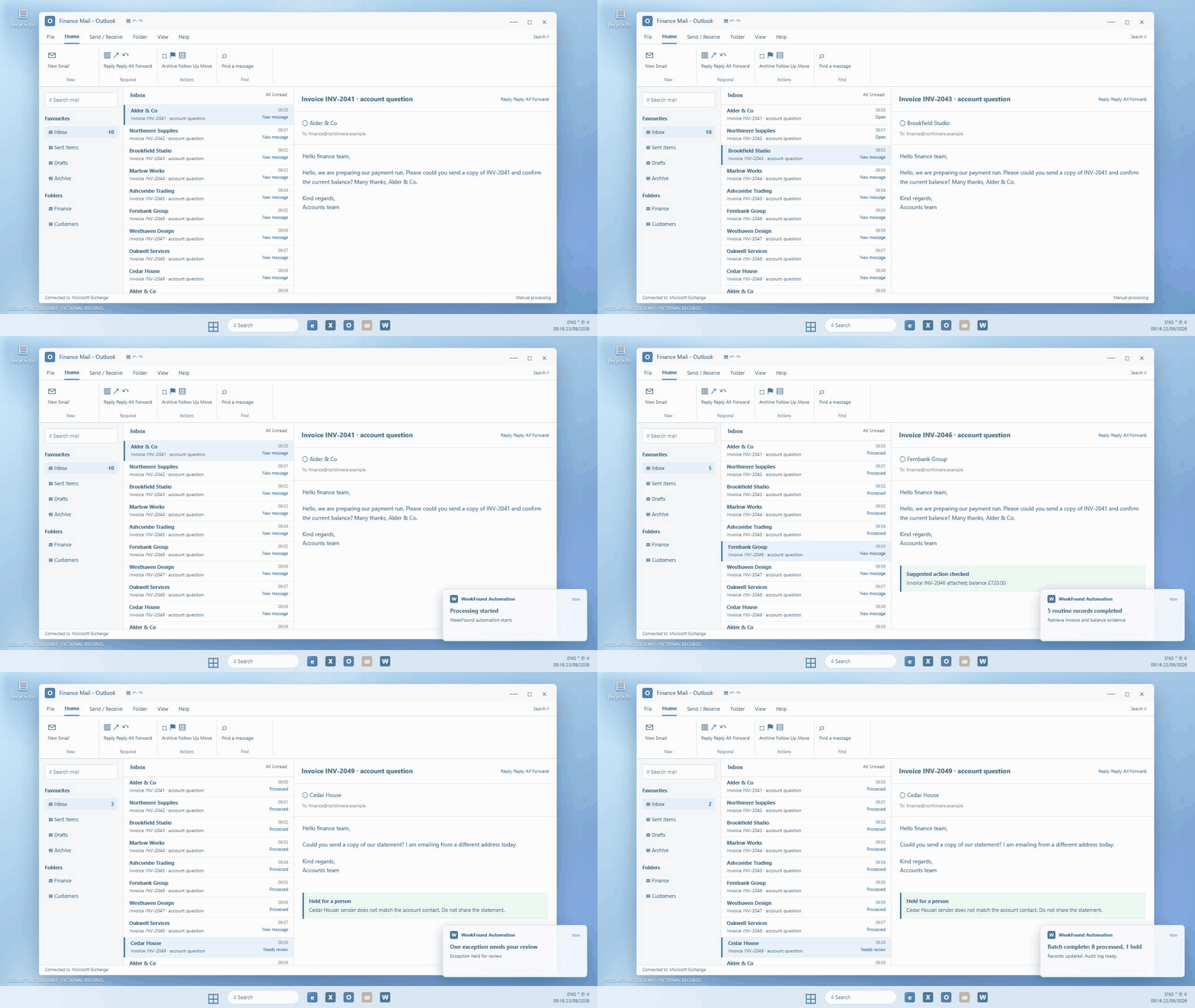
This short GIF reconstructs the manual task and the proposed automation using fictional records. It shows the ordinary items progressing and an exception held for a person. The time saving below is an illustrative target.

Finance inbox & account queries: a reconstructed Windows desktop showing routine work processed and an exception held for reviewDownload this GIF ↓

Less rework. More room to move the business forward.

The proposed design would handle repeatable steps, check work before it moves on and give people more capacity for decisions that matter. These benefits would need testing with a real team.

01 / CAPACITY

More time for the work that matters

Routine steps could move forward without repeated manual handling, while people stay involved when judgement is needed. Any time saved would be measured in a pilot.

02 / QUALITY

Fewer avoidable errors

Verified account matching and answers grounded in the current records would reduce wrong balances, missing context and invoices sent to the wrong person.

03 / OPPORTUNITY

Time to improve the business and its profitability

People could focus on resolving difficult cases, understanding recurring customer problems and improving service, rather than searching for the same records all day.

BEFORE · MANUAL PROCESS

Every step waits for a person.

  1. Sort the shared inbox
  2. Search accounts and old conversations
  3. Find invoices and write replies
  4. Log the outcome and chase missing details
PROPOSED WORKFLOW

Routine work progresses. Exceptions reach the team.

  1. Classify and link each conversation
  2. Retrieve the actual evidence
  3. Complete permitted routine requests
  4. Keep the work moving

One connected process, from arrival to checked result.

  1. 01

    Classify and link each conversation

    Group replies into their existing thread, identify the request and match the sender to a verified account. Unknown senders and uncertain account matches go to review.
  2. 02

    Retrieve the actual evidence

    Find the relevant invoice, statement, payment status and approved policy. Prepare answers from these records, with links back to the evidence and no invented balances or commitments.
  3. 03

    Complete permitted routine requests

    Send approved template responses for low-risk requests such as invoice copies or recorded payment status after identity and attachment checks. Draft disputes, refunds and sensitive messages for approval.
  4. 04

    Keep the work moving

    Log the response against the account, set the next action, detect unanswered requests and provide a daily exception queue. Recheck current thread state before sending to avoid replying twice.

Work inside the systems the team already uses.

Shared mailbox, customer and supplier records, document archive and the finance system. The same permissions apply to retrieval and outbound attachments.

The judgement stays with your people.

People handle complaints, disputes, concessions and any request that cannot be answered from verified records. Automatic replies would be limited to approved routine categories; other replies would need review.

Prove the saving before calling it a result.

  1. 01

    Baseline the real work

    Observe at least two representative working weeks, including routine cases and exceptions. Agree the scope, volumes, quality checks and staff minutes before building.
  2. 02

    Connect, then run alongside the team

    Confirm system access, build the intake, rules, exception queue and audit history. Compare proposed actions with human decisions before enabling writes or sending messages.
  3. 03

    Pilot a controlled slice

    Enable only agreed actions, with duplicate protection, alerts and a pause control. Keep a manual fallback and expand only when the quality checks pass.
  4. 04

    Measure the complete cost in time

    Measure correct resolutions, reopened queries, incorrect disclosures, response time and total staff handling time. Run draft-only first and enable automatic responses only for categories that pass review. Compare a representative post-pilot period with the same scope and workload; report the observed result, including review and correction time.

Could this help your business?

Get in touch and we’ll talk through what you’d like to improve, then explore whether a similar finance automation approach makes sense for you.

Get a free Time-Back Review →