← Proposed workflows

ROLE AUTOMATION STUDY · 9 of 20 companies in our first outreach sample

Reconciliation & management reporting

Collect the source data, match the records and prepare recurring reports before the team starts its review.

ILLUSTRATIVE PROPOSAL · NOT A MEASURED CLIENT RESULT

See the work happen on screen.

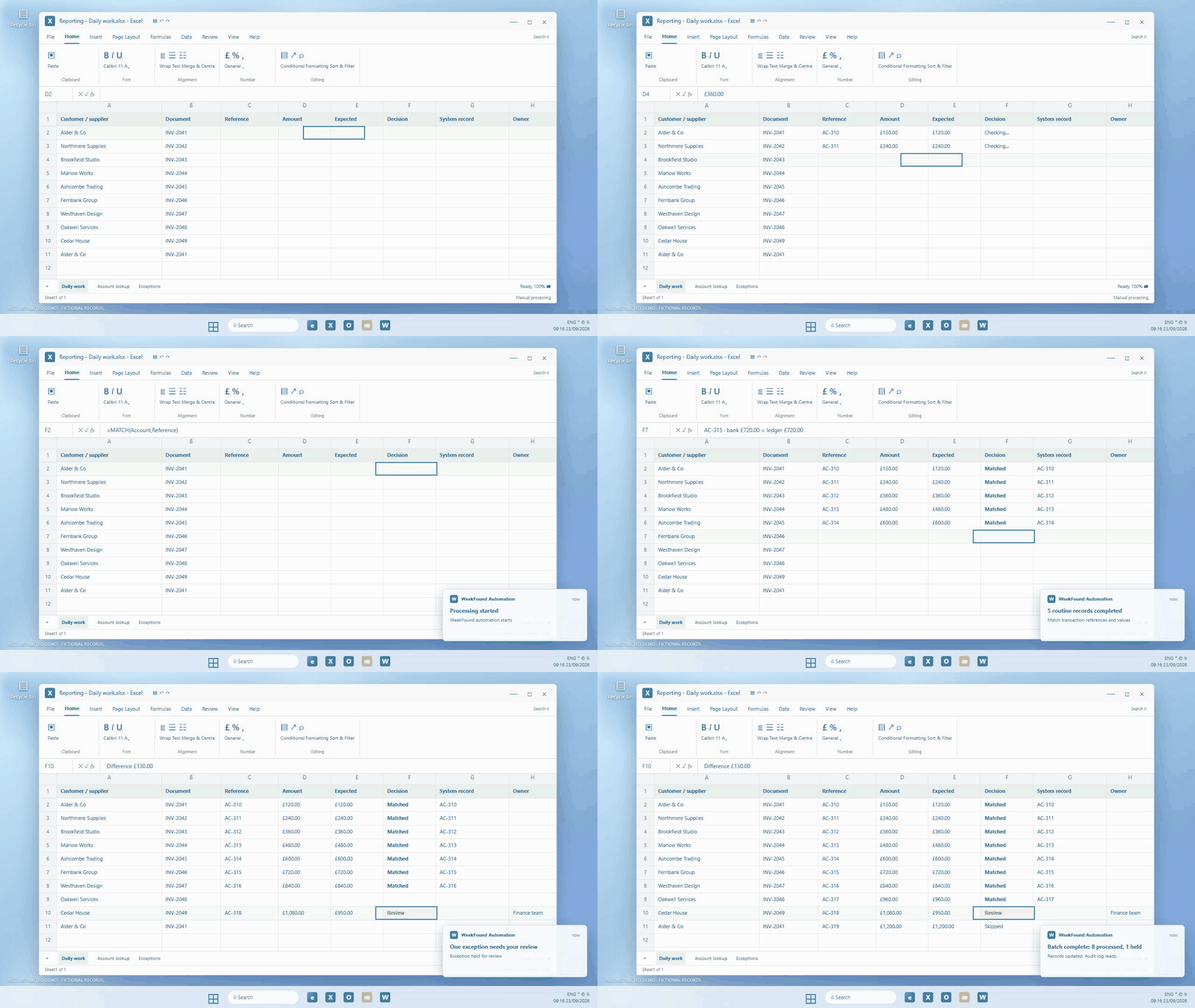
This short GIF reconstructs the manual task and the proposed automation using fictional records. It shows the ordinary items progressing and an exception held for a person. The time saving below is an illustrative target.

Reconciliation & management reporting: a reconstructed Windows desktop showing routine work processed and an exception held for reviewDownload this GIF ↓

Less rework. More room to move the business forward.

The proposed design would handle repeatable steps, check work before it moves on and give people more capacity for decisions that matter. These benefits would need testing with a real team.

01 / CAPACITY

More time for the work that matters

Routine steps could move forward without repeated manual handling, while people stay involved when judgement is needed. Any time saved would be measured in a pilot.

02 / QUALITY

Fewer avoidable errors

Freshness checks, control totals and visible unmatched items would catch missing data and spreadsheet differences before a report is used for decisions.

03 / OPPORTUNITY

Time to improve the business and its profitability

Finance could use the morning to explain what changed, investigate margins and help managers choose where to reduce costs or invest for growth.

BEFORE · MANUAL PROCESS

Every step waits for a person.

  1. Download source reports
  2. Clean and combine spreadsheets
  3. Match balances and investigate gaps
  4. Refresh reports and distribute them
PROPOSED WORKFLOW

Routine work progresses. Exceptions reach the team.

  1. Scheduled source collection
  2. Repeatable reconciliation
  3. Traceable report preparation
  4. Review and release

One connected process, from arrival to checked result.

  1. 01

    Scheduled source collection

    Retrieve agreed files or API data on a schedule. Check completeness, date ranges and freshness; stop publication if a required source is missing or stale.
  2. 02

    Repeatable reconciliation

    Normalise identifiers and dates, match transactions using documented rules and reconcile totals. Keep unmatched items visible rather than creating balancing entries to hide differences.
  3. 03

    Traceable report preparation

    Refresh approved calculations and dashboards from the reconciled dataset. Attach source references, timestamps and explanations for flagged movements; mark incomplete outputs clearly.
  4. 04

    Review and release

    Present exceptions and control totals to the reviewer, retain version history and distribute approved outputs to the agreed audience. Failed runs trigger a visible alert and safe rerun.

Work inside the systems the team already uses.

Accounting exports, authorised bank data, operational systems, spreadsheets and the existing reporting destination. Any interface between systems such as CMAP and Xero must be validated for the customer's setup.

The judgement stays with your people.

Finance retains judgement about unexplained differences, journal approval, commentary and report sign-off. Analytical decisions and statutory reporting are outside this routine preparation model.

Prove the saving before calling it a result.

  1. 01

    Baseline the real work

    Observe at least two representative working weeks, including routine cases and exceptions. Agree the scope, volumes, quality checks and staff minutes before building.
  2. 02

    Connect, then run alongside the team

    Confirm system access, build the intake, rules, exception queue and audit history. Compare proposed actions with human decisions before enabling writes or sending messages.
  3. 03

    Pilot a controlled slice

    Enable only agreed actions, with duplicate protection, alerts and a pause control. Keep a manual fallback and expand only when the quality checks pass.
  4. 04

    Measure the complete cost in time

    Reconcile outputs to approved manual reports, test missing and late inputs, and measure preparation plus correction and sign-off time. A fast report with stale data does not count as a successful run. Compare a representative post-pilot period with the same scope and workload; report the observed result, including review and correction time.

Could this help your business?

Get in touch and we’ll talk through what you’d like to improve, then explore whether a similar reporting automation approach makes sense for you.

Get a free Time-Back Review →