← Proposed workflows

ROLE AUTOMATION STUDY · 3 of 20 companies in our first outreach sample

Quotes, orders & CRM administration

Convert complete customer requests into checked quotations, approved orders and current CRM records with less rekeying.

ILLUSTRATIVE PROPOSAL · NOT A MEASURED CLIENT RESULT

See the work happen on screen.

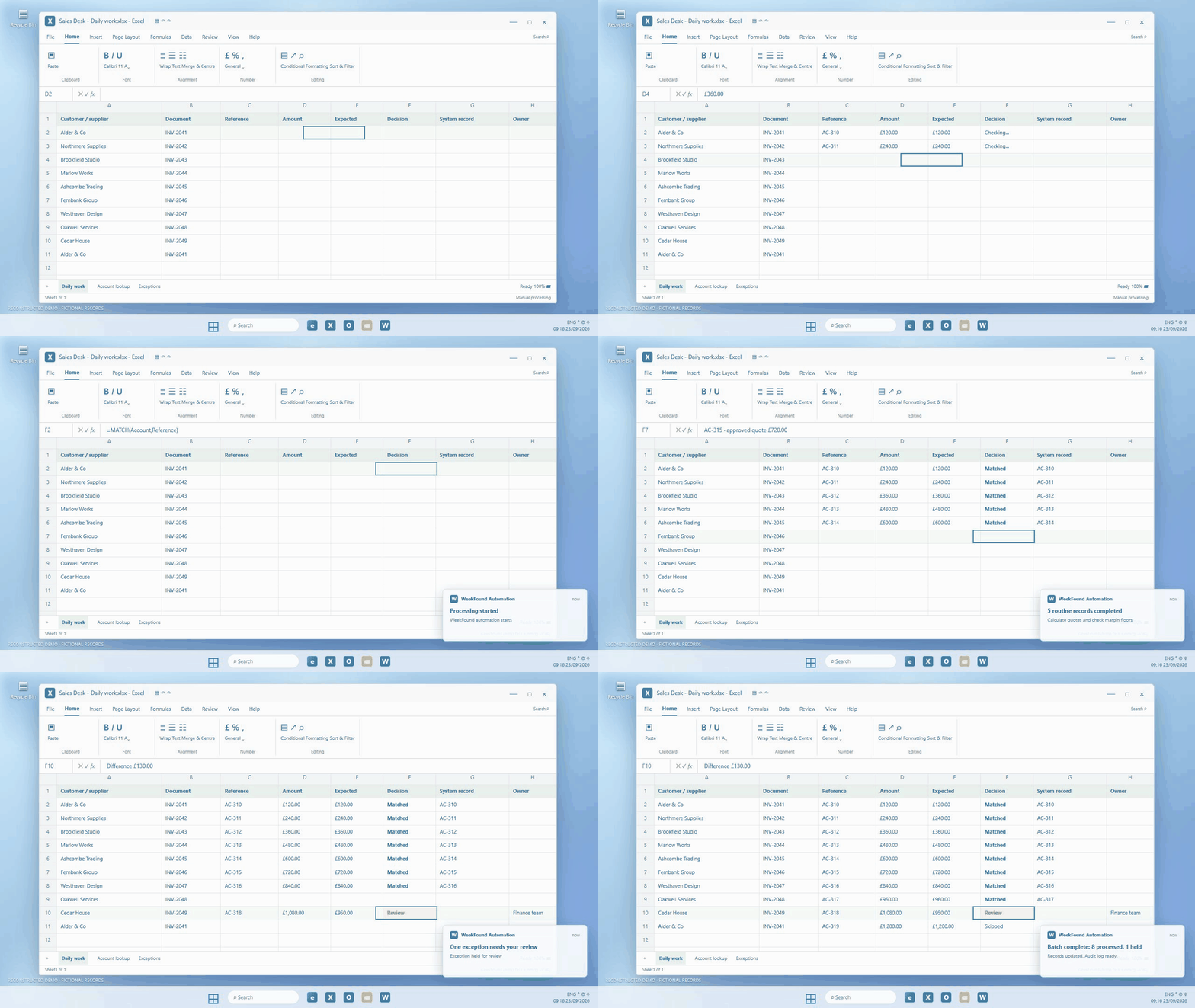
This short GIF reconstructs the manual task and the proposed automation using fictional records. It shows the ordinary items progressing and an exception held for a person. The time saving below is an illustrative target.

Quotes, orders & CRM administration: a reconstructed Windows desktop showing routine work processed and an exception held for reviewDownload this GIF ↓

Less rework. More room to move the business forward.

The proposed design would handle repeatable steps, check work before it moves on and give people more capacity for decisions that matter. These benefits would need testing with a real team.

01 / CAPACITY

More time for the work that matters

Routine steps could move forward without repeated manual handling, while people stay involved when judgement is needed. Any time saved would be measured in a pilot.

02 / QUALITY

Fewer avoidable errors

Approved price rules, margin floors and a check before order creation would reduce misquotes, duplicate orders and outdated CRM records.

03 / OPPORTUNITY

Time to improve the business and its profitability

Salespeople could spend more time advising customers, improving the offer and pursuing opportunities with healthy margins. Any profit uplift would need separate measurement.

BEFORE · MANUAL PROCESS

Every step waits for a person.

  1. Read enquiries and collect missing details
  2. Look up prices, stock and delivery
  3. Build quotes and follow up
  4. Rekey accepted orders and update the CRM
PROPOSED WORKFLOW

Routine work progresses. Exceptions reach the team.

  1. A structured enquiry
  2. Deterministic quote calculation
  3. Controlled quote follow-up
  4. Acceptance to order

One connected process, from arrival to checked result.

  1. 01

    A structured enquiry

    Read incoming requests, identify the customer and requested products, and ask for missing quantities or delivery details. Ambiguous specifications go to the sales team.
  2. 02

    Deterministic quote calculation

    Use the approved product catalogue, customer price rules, delivery costs and margin floor to calculate the quote. AI can interpret the request and draft wording; it does not invent prices, stock or discounts.
  3. 03

    Controlled quote follow-up

    Issue quotes within agreed authority, track expiry and prepare or send permitted reminders. Check for replies, acceptance and previous contact before scheduling another message.
  4. 04

    Acceptance to order

    Verify acceptance against the latest quote, recheck availability and commercial rules, create the order once and update the CRM. Route changed terms, expired prices and credit issues to approval.

Work inside the systems the team already uses.

Sales inbox, product and stock records, pricing engine, CRM and order system. Salesforce or another CRM would be connected according to the customer's existing setup.

The judgement stays with your people.

Salespeople retain product advice, negotiations, unusual specifications, discounts outside policy and relationship management. The model measures standard quote-to-order admin, not the complete sales role.

Prove the saving before calling it a result.

  1. 01

    Baseline the real work

    Observe at least two representative working weeks, including routine cases and exceptions. Agree the scope, volumes, quality checks and staff minutes before building.
  2. 02

    Connect, then run alongside the team

    Confirm system access, build the intake, rules, exception queue and audit history. Compare proposed actions with human decisions before enabling writes or sending messages.
  3. 03

    Pilot a controlled slice

    Enable only agreed actions, with duplicate protection, alerts and a pause control. Keep a manual fallback and expand only when the quality checks pass.
  4. 04

    Measure the complete cost in time

    Compare prices and margins to approved manual quotes, test duplicate acceptance and changed stock, and measure rework, order accuracy and staff handling time. Track conversion separately. Compare a representative post-pilot period with the same scope and workload; report the observed result, including review and correction time.

Could this help your business?

Get in touch and we’ll talk through what you’d like to improve, then explore whether a similar quote automation approach makes sense for you.

Get a free Time-Back Review →