01
See the current relationship
Open a customer record to review contacts, previous orders and the current quotation before deciding what to do next.

Sales and customer relationships · Showroom demonstration
A quote can sit in a spreadsheet, a customer reply in an inbox and the latest order in another system. Before following up, someone has to reconstruct what happened. As the customer list grows, keeping that context current becomes a job of its own.
Who this is for: B2B sales teams, wholesalers and businesses with repeat customers and open quotations.
CRM
This CRM demonstration brings the customer, quotation and next action into one working view. The aim is to reduce the repeated administration around the relationship, so the sales team has more capacity for useful conversations.
In the fictional example, Alder Workshop has an open quote and previous orders. A salesperson opens the customer history, reviews the quote and records that the customer needs a revised specification. That update appears on the customer timeline, where another colleague can find it.
The demo also shows a credit application and an example receipt allocated to a quote. These are separate steps with separate evidence: sending a follow-up is not a confirmed sale, and allocating a receipt to a new quote does not clear an older outstanding invoice.
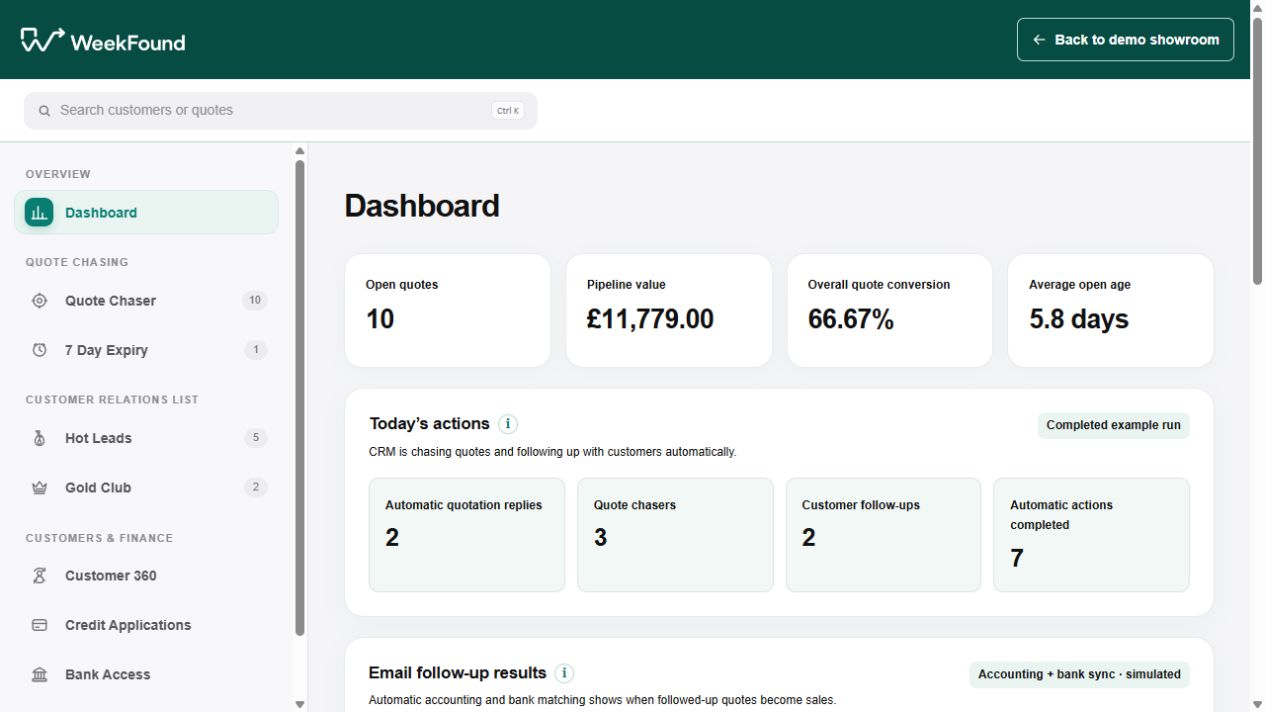
From the repeated task to a reviewable result
01
Open a customer record to review contacts, previous orders and the current quotation before deciding what to do next.
02
Review a quote and record the actual customer update. Keep the next action with the customer rather than in a separate reminder list.
03
Try a fictional application, simulated credit report and reviewed credit-limit update. No real credit service is contacted.
04
Inspect an example bank receipt and allocate it to a valid quotation. The fictional sales result changes after the allocation, rather than after a message alone.
Practical answers
Use the quote status together with the latest conversation and recorded next action. A request for a revised specification should change the follow-up, not trigger the same reminder again. A production workflow would recheck those records immediately before any permitted message.
Not necessarily. First identify which system owns the customer, quotation, order and payment records. The right project may connect those records or add a working view around them. This demo shows the workflow; it does not prove that your current software has a suitable connection.
Yes. The demo includes previous orders and customer activity alongside an open quote. That context is useful when a colleague needs to understand a returning customer’s requirements. It supports the relationship rather than treating every conversation as a new lead.
No. The demo separates the simulated email action from the evidence confirming the order. A live measurement should distinguish messages sent, replies, accepted quotes and confirmed sales, using agreed records for each stage.
The example includes application details, a simulated credit report and a reviewed credit-limit update. In a real build, authorised access, the credit policy and approval responsibilities would be agreed first. The demonstration does not perform a real credit check or make a lending decision.
Build relationships, interpret what customers need, negotiate unusual terms and make the important decisions. Repeated record gathering and follow-up administration can support that work. In the demo, a person reviews the customer context and decides the next step.
Measure the time spent finding customer context and administering follow-ups, then compare it with the automation cost. Also record missed follow-ups, corrections and the quality of customer conversations. Only attribute a sale to a follow-up where the evidence supports it.
Your business and existing tools
Start with one recurring handoff, such as an open quote that requires a checked follow-up. Our sales automation approach begins with the actual sales process. The quote follow-up guide explains the status and conversation checks, while services and pricing sets out how WeekFound projects and ongoing support are offered.
WeekFound starts by looking at the repeated work, the time the team spends on it and the mistakes that need correcting. The aim is to give the existing team more capacity as the business grows.
The salesperson owns the relationship and the commercial decision. Credit approvals, unusual terms and ambiguous payment matches remain with the responsible person.
Count the time spent assembling the customer history, managing the quote queue and correcting records. Review confirmed customer outcomes separately from activity counts. The fictional dashboard figures are examples, not measured WeekFound client results.
Start with one useful piece of work
Tell us how the task works today, where it gets stuck and what a correct result needs to look like. We can then assess the work, the source data and the review points before agreeing a suitable approach. Essential work should retain a usable manual fallback if an automation or source system changes.
Discuss this workflow