01
Read the current reporting view
Review sales, contribution and the available cost coverage for the fictional order set.

Finance and commercial reporting · Showroom demonstration
The sale value is usually easy to find. The product cost, inbound freight, outbound delivery, provider fees and attributable advertising costs may sit elsewhere. Until they are joined correctly, an order can appear more profitable than the available evidence supports.
Who this is for: Stockholding businesses, online sellers and wholesalers reviewing order-level margins and cost coverage.
Order profitability
This demonstration links the fictional order to its attributed costs and shows their basis in a cost trace. The reviewer can see how the contribution was calculated and what needs checking before relying on the result.
In the fictional example, Alder Workshop has an order with net sales and several attributed costs. The finance reviewer finds the order and opens the cost trace, bringing the product, delivery, fees and advertising amounts into the same review.
The result is useful because the supporting basis is visible, not simply because a margin percentage is displayed. The showroom uses prepared example evidence and makes no accounting write. The actual matching and allocation rules for a business would need separate agreement.
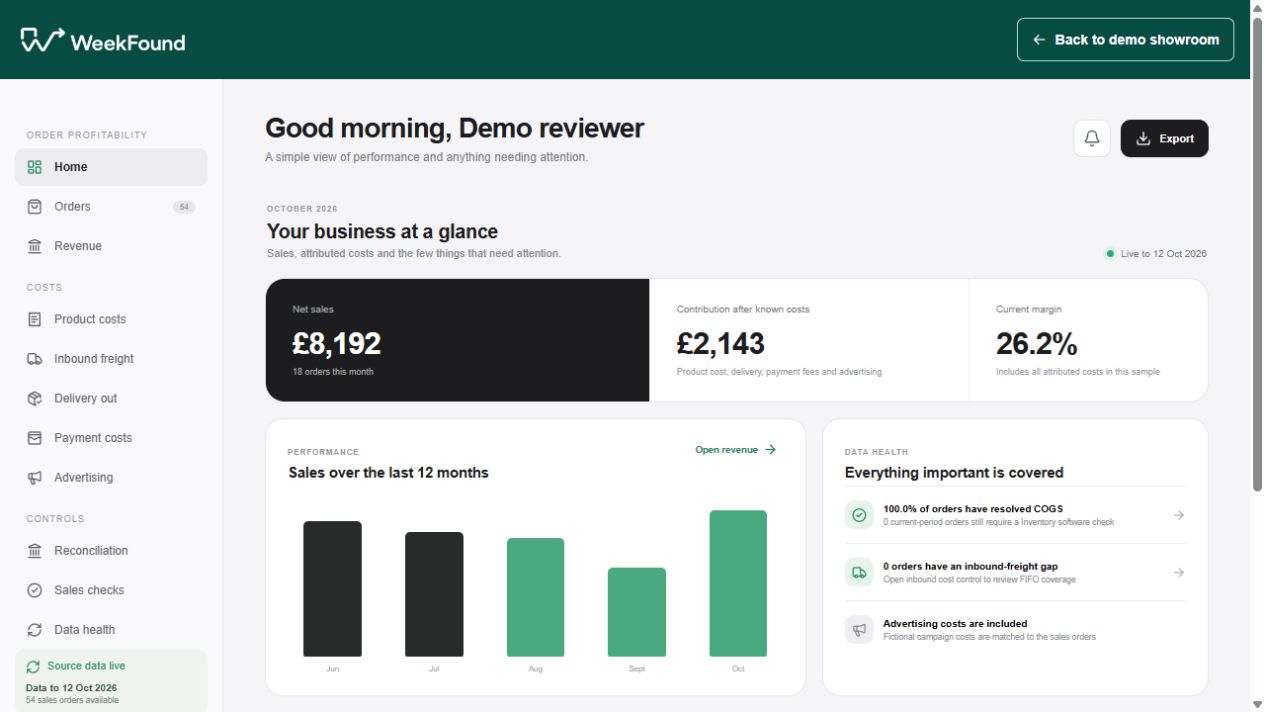
From the repeated task to a reviewable result
01
Review sales, contribution and the available cost coverage for the fictional order set.
02
Search by an order reference or customer and open the relevant record.
03
Inspect product costs, delivery in, delivery out, provider fees and advertising costs in the order drawer.
04
Review trace status and the product-cost basis before using the contribution or margin in a decision.
Practical answers
Define that for the decision the report supports. This demo shows product costs, inbound and outbound delivery, provider fees and attributed advertising costs alongside net sales. Other businesses may need returns, discounts or additional allocations. Document what is included and what remains outside the measure.
No. A contribution measure based on selected order costs does not automatically include every overhead, tax or wider business expense. Label the cost basis clearly so the reviewer understands what the number means. The demo’s result is an order view, not a complete set of company accounts.
An incomplete cost record should stay visible as a gap, not be silently treated as a confirmed zero. Agree whether the report uses a documented estimate or marks the result incomplete. The team needs to know which orders can be relied on and which require another check.
Keep the matched source and the chosen cost basis with the order. The demonstration’s cost trace includes a fictional linked-purchase basis. For a production report, validate the identifiers, dates and allocation logic against manually checked transactions.
Sometimes, if suitable attribution data and a defensible allocation method are available. The demo contains fictional attributed amounts. A live report should explain the attribution basis and leave unavailable attribution explicit, rather than assume every marketing cost can be traced accurately to one order.
Not necessarily. A reporting layer may join authorised records from the systems already used. First check the sources, available access and matching identifiers. This showroom does not establish a live accounting or inventory connection and does not post adjustments.
Choose a set of orders with known sales and costs, including an incomplete or awkward example. Recalculate them manually, reconcile the relevant totals and inspect every allocation. Measure report preparation plus correction and review time, then repeat the checks when a source or rule changes.
Your business and existing tools
Start with the cost questions the business actually needs to answer. The order profitability guide covers missing-cost checks, while the order profitability case study describes related completed reporting work. Our reporting automation approach explains how reliable source collection and review fit around the existing reports.
WeekFound starts by looking at the repeated work, the time the team spends on it and the mistakes that need correcting. The aim is to give the existing team more capacity as the business grows.
Finance agrees the cost and allocation basis, checks incomplete records and signs off how the report may be used. A plausible margin is not a substitute for supporting evidence.
Measure the time spent collecting costs, matching records and correcting the report. Review completeness and reconciliation as well as speed. A prepared fictional dashboard cannot establish a real profit increase or a verified saving.
Start with one useful piece of work
Tell us how the task works today, where it gets stuck and what a correct result needs to look like. We can then assess the work, the source data and the review points before agreeing a suitable approach. Essential work should retain a usable manual fallback if an automation or source system changes.
Discuss this workflow