01
Find the product
Search the example catalogue and open the product whose market position needs review.

Pricing and market awareness · Showroom demonstration
Opening the same competitor listings, writing prices into a spreadsheet and checking whether a product is available can take time before the pricing discussion even starts. A low headline price is also less useful if it refers to the wrong product or an unavailable offer.
Who this is for: Retailers, wholesalers and commercial teams reviewing comparable products across several sellers.
Competitor price monitoring
This demonstration brings prepared competitor observations into a product view. It helps a reviewer see where the example product sits, which offers are in stock and what prices have changed. The pricing decision remains a separate piece of work.
The fictional product has several seller listings. The commercial team opens the product and compares the prices, availability and recorded movements together. It can see that a cheaper offer exists without immediately concluding that its own price must fall.
A reviewer can then check whether the listings are genuinely comparable and whether stock, delivery, service or margin changes the decision. The showroom’s refresh uses prepared example values; it does not visit competitor websites.
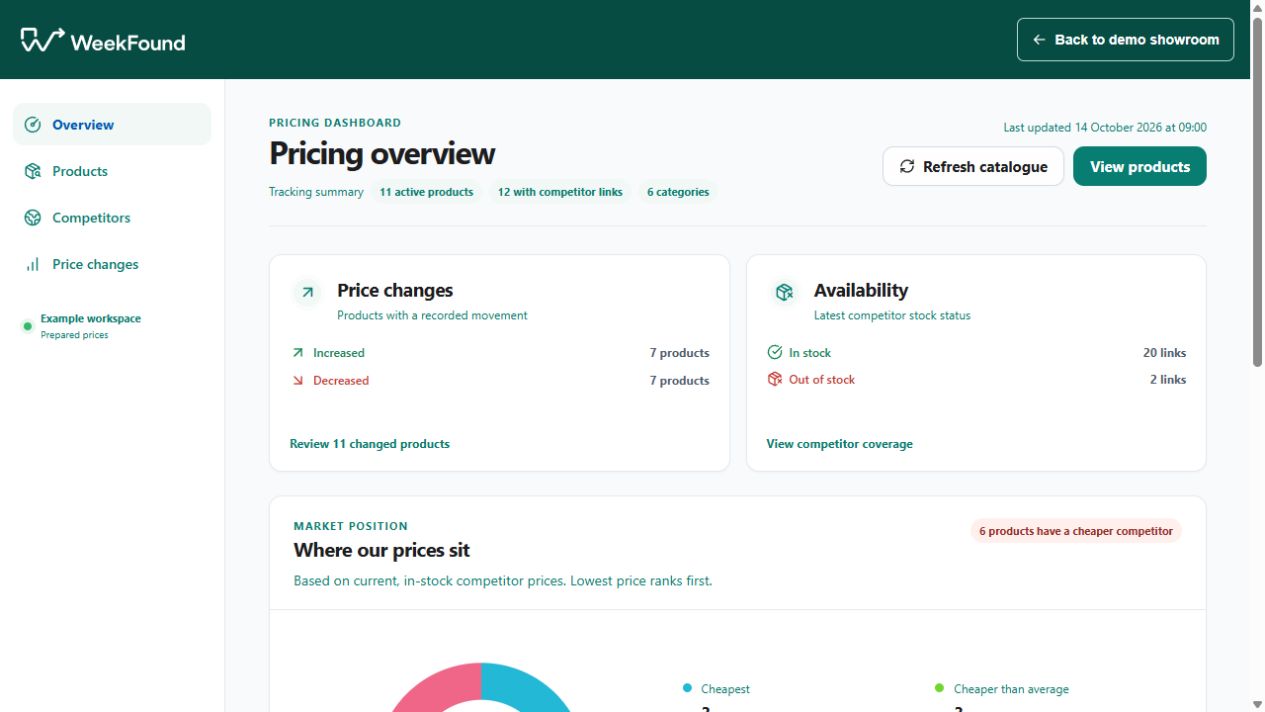
From the repeated task to a reviewable result
01
Search the example catalogue and open the product whose market position needs review.
02
Review each seller’s prepared price, movement and stock status beside the example business’s own listing.
03
Follow a price movement back to the product and see the offers behind the market position.
04
Use the evidence to decide whether to review the selling price, check a listing match or leave the price alone. The demo does not publish a new price.
Practical answers
Agree the matching rules before relying on a comparison: product identity, variant, size, quantity and what the offer includes. This demo uses prepared listing matches. A production workflow would need a review route for ambiguous matches rather than accepting a similar-looking name automatically.
They should be visible as a different kind of evidence. An unavailable low-price offer is not the same as a product a buyer can order today. The demo keeps stock status beside the price so the reviewer can judge its relevance.
The price basis needs to be agreed. Compare like with like and identify whether VAT, delivery or pack quantities are included. The showroom is a product-price and availability example; a full delivered-price comparison would need the relevant cost and delivery data.
No. This demonstration provides observations for review. A decision to lower a price should consider your margin, stock and commercial position. Automatic repricing would be a separate scope with explicit rules and approval boundaries.
Choose a frequency that fits how quickly the market moves and how often the business can act. More frequent data is useful only if it is reliable and relevant. The showroom’s history is fictional and its refresh does not establish a live collection schedule.
A production design should flag the missing or uncertain observation instead of treating an old price as current. Someone needs to review the product match or source change. The showroom contains prepared observations, so live collection failure handling is a requirement to assess separately.
Measure the preparation work it replaces, the accuracy of listing matches and how often the evidence leads to a useful pricing review. Keep that separate from any sales or margin result. A change in market awareness does not by itself prove a financial improvement.
Your business and existing tools
Begin with a small set of products and agreed comparison rules. The competitor price monitoring case study describes related completed work separately from this fictional demo. Our business automation approach explains how we assess the repeated process, and services and pricing gives the current service structure.
WeekFound starts by looking at the repeated work, the time the team spends on it and the mistakes that need correcting. The aim is to give the existing team more capacity as the business grows.
The commercial team checks product comparability and decides whether a market movement justifies a change. Observing a competitor price does not authorise a new selling price.
Check how much time goes on gathering the listings and how often comparisons need correction. Record which decisions used reliable evidence. The fictional market positions do not establish a live ranking, a price advantage or a client outcome.
Start with one useful piece of work
Tell us how the task works today, where it gets stuck and what a correct result needs to look like. We can then assess the work, the source data and the review points before agreeing a suitable approach. Essential work should retain a usable manual fallback if an automation or source system changes.
Discuss this workflow